


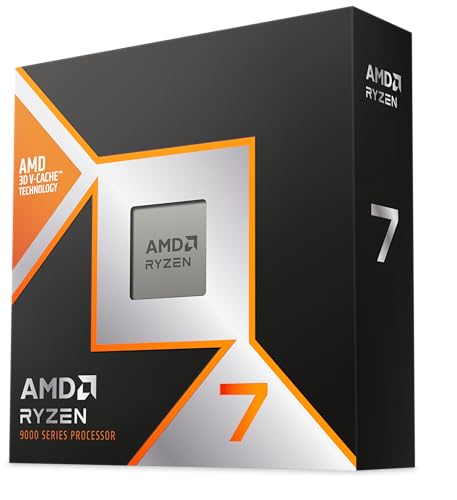

For an RTX 5090 gaming build, an AM5 X3D processor such as the Ryzen 7 9800X3D is a focused option, while the Ryzen 9 9950X3D adds 16 cores for a mix of gaming and content creation. If you are upgrading an older AM4 system, the Ryzen 7 5800X3D or Ryzen 7 5700X may avoid a platform change, but confirm your motherboard and memory before buying.
This guide to the best CPUs for RTX 5090 compares socket, core count, cache, memory generation, and the trade-off between gaming-focused parts and broader workloads. Some listings are complete RTX 5090 desktops or a graphics card rather than standalone processors, so check the product type carefully before ordering.
Compare at a glance
| Product | Brand | Size | Weight | Stands out for | Price |
|---|---|---|---|---|---|
| 1 AMD Ryzen 5 9600X 6-Core Processor | AMD | 1.57 × 1.57 × 0.04 in | 0.2 lb | Six cores and 12 threads | Check price |
| 2 AMD Ryzen 7 5800X3D 8-Core Processor | AMD | 1.57 × 1.57 × 0.1 in | 0.2 lb | Eight cores and 16 threads | Check price |
| 3 AMD Ryzen 7 9800X3D 8-Core Processor | AMD | 1.97 × 1.97 × 0.04 in | 0.2 lb | 96MB L3 cache | Check price |
| 4 AMD Ryzen 7 7800X3D, 8-Core CPU | AMD | 5.12 × 3.58 × 5.08 in | 0.7 lb | Eight cores and 16 threads | Check price |
| 5 AMD Ryzen 7 5700X 8-Core Processor | AMD | 1.57 × 1.57 × 0.24 in | 0.3 lb | 8 cores and 16 threads | Check price |
| 6 AMD Ryzen 9 9950X3D 16-Core Processor | AMD | 1.6 × 1.6 × 0.1 in | 0.2 lb | 16-core desktop processor | Check price |
| 7 ASUS ROG Astral LC RTX 5090 32GB | ASUS | 11.36 × 6.05 × 0.04 in | 2.2 lb | Full-surface cooling for GPU, VRMs, and memory | Check price |
| 8 Empowered PC Sentinel Wood RTX 5090 Desktop | Empowered PC | Not listed | 50 lb | RTX 5090 with 32GB GDDR7 memory | Check price |
| 9 Empowered PC Panorama XL RTX 5090 | Empowered PC | Not listed | 14 lb | RTX 5090 with 32GB GDDR7 | Check price |
| 10 HP OMEN MAX 45L, Ryzen 9 9900X3D | HP | 21.85 × 18.5 × 8.03 in | 50 lb | GeForce RTX 5090 graphics | Check price |
Sizes and weights as listed by the manufacturer on Amazon. Check the retailer for current price and availability.
Pros
- Six cores and 12 threads
- Unlocked for overclocking
- DDR5-5600 support
Cons
- Cooler is not included
- Who should skip it: owners of non-AM5 motherboards
Pros
- Eight cores and 16 threads
- 100 MB cache
- DDR4-3200 support
- PCIe 4.0 support on X570 and B550
Cons
- Cooler not included; high-performance cooler recommended
- Who should skip it: builders not using Socket AM4
Pros
- 96MB L3 cache
- Socket AM5 compatibility
- Up to 5.2GHz stated clock speed
Cons
- Who should skip it: buyers who need an included cooler

Pros
- Eight cores and 16 threads
- 96 MB L3 cache
- Integrated AMD Radeon Graphics controller
Cons
- Who should skip it: users needing more than eight CPU cores

Pros
- 8 cores and 16 threads
- Unlocked for overclocking
- DDR4-3200 support
Cons
- Cooler not included
- Requires a discrete graphics card
- Who should skip it: builders seeking a processor with integrated graphics

Pros
- 16-core desktop processor
- Up to 5.7 GHz boost clock
- AM5 platform
Cons
- Who should skip it: buyers looking for a laptop processor

Pros
- Full-surface cooling for GPU, VRMs, and memory
- Magnetic daisy-chain fans
- Onboard fan and low-profile heatsink
Cons
- Who should skip it: builders whose cases cannot accommodate a 360 mm radiator

Pros
- RTX 5090 with 32GB GDDR7 memory
- 64GB DDR5 and 4TB Gen4 NVMe storage
- Windows 11 Pro included
- Three-year limited hardware warranty
Cons
- Additional display ports may vary
- Who should skip it: buyers needing a confirmed, specific selection of additional display ports

Pros
- RTX 5090 with 32GB GDDR7
- 64GB DDR5 memory
- 2TB Gen4 NVMe SSD
- Three-year limited hardware warranty
Cons
- Who should skip it: buyers needing a confirmed full port count
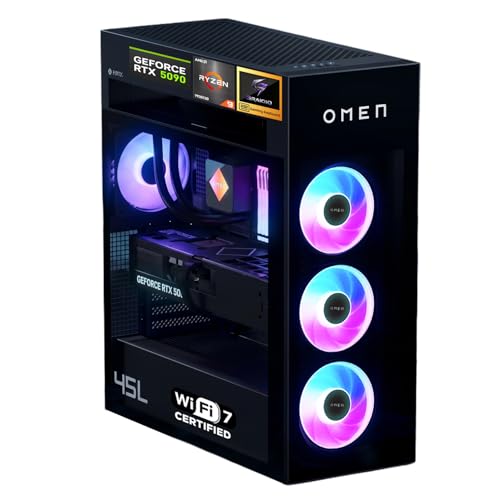
Pros
- GeForce RTX 5090 graphics
- 96GB DDR5 memory
- 4TB SSD
- Wi-Fi 7 and Bluetooth 5.4
Cons
- Who should skip it: buyers needing a lightweight, easily moved PC
Best Gaming-Focused AM5 CPU: AMD Ryzen 7 9800X3D 8-Core Processor
The AMD Ryzen 7 9800X3D 8-Core Processor combines 8 cores and 16 threads with 96 MB of L3 cache and AM5 support, making it a clear fit for a gaming-focused new build. Its stated boost clock reaches 5.2 GHz, and the listing says a cooler is not included. Skip it if your existing system uses AM4 or you need more than 8 CPU cores for heavily parallel work.
Best for Gaming and Creation: AMD Ryzen 9 9950X3D 16-Core Processor
The AMD Ryzen 9 9950X3D 16-Core Processor has 16 cores, 32 threads, and a listed boost clock up to 5.7 GHz, which makes it the strongest fit here for combining gaming with CPU-heavy creative work. It uses the AM5 platform, so pair it with a compatible AM5 motherboard and DDR5 memory. Skip it if your priority is gaming alone and you would rather avoid paying for cores your applications will not use.
Best for an Older AM4 Build: AMD Ryzen 7 5800X3D 8-Core Processor
The AMD Ryzen 7 5800X3D 8-Core Processor supports Socket AM4 and DDR4-3200, with 8 cores, 16 threads, and 100 MB of cache listed. That can make it worth considering when retaining an AM4 motherboard and DDR4 memory matters more than moving to a newer platform. Confirm motherboard support and BIOS requirements with its manufacturer, and note that a cooler is not included. Skip it if you are building on AM5 or want DDR5 support.
Key Numbers at a Glance
- The Ryzen 7 9600X has 6 cores and 12 threads; the Ryzen 7 9800X3D has 8 cores and 16 threads.
- The Ryzen 9 9950X3D lists 16 cores and 32 threads, twice the core count of the 8-core Ryzen 7 9800X3D.
- The Ryzen 7 5800X3D lists 100 MB of cache, while the Ryzen 7 9800X3D lists 96 MB of L3 cache. These figures describe different cache categories, so do not treat them as a direct like-for-like measure.
- The Ryzen 7 5700X supports DDR4-3200, while the Ryzen 5 9600X supports DDR5-5600.
Buying Guide for the Best CPUs for RTX 5090
Match the CPU to the game and workload
Bottom line: For gaming-led builds, compare X3D models first; choose a higher core count when your other work can use it. The Ryzen 7 9800X3D has 8 cores and 16 threads with 96 MB L3 cache, while the Ryzen 9 9950X3D has 16 cores and 32 threads. That extra core capacity is more relevant to demanding creation or multitasking than to every game, so base your choice on the software you actually use.
At high resolutions, games can lean heavily on the graphics card, while high-refresh-rate play and CPU-heavy titles can make processor choice more consequential. There is no supplied benchmark comparison here, so do not infer a specific frame-rate advantage from core count or clock speed alone.
Check socket, motherboard, and BIOS compatibility
Bottom line: Match the CPU socket to the motherboard before comparing clock speeds. The Ryzen 5 9600X, Ryzen 7 9800X3D, and Ryzen 9 9950X3D use AM5; the Ryzen 7 5800X3D and Ryzen 7 5700X use AM4. A processor cannot be selected by socket alone: verify the exact motherboard’s CPU support list and any BIOS update needs.
An AM4 upgrade can preserve existing DDR4 memory when the board supports the chosen CPU, while AM5 models in this selection use DDR5. For broader processor and component comparisons, browse the Processors category and the PC Components category.
Account for memory generation and your upgrade plan
Bottom line: Avoid choosing a CPU until you know whether your build uses DDR4 or DDR5. The Ryzen 7 5700X lists DDR4-3200 support; the Ryzen 5 9600X lists DDR5-5600 support. Those memory generations are not interchangeable, so a move from AM4 to AM5 can involve replacing both the motherboard and memory, depending on your current parts.
Make a parts list before ordering, including motherboard model and memory type. If you want a longer platform upgrade path, compare the cost and features of a full platform change against a compatible AM4 CPU upgrade rather than assuming the newest generation is automatically the right choice.
Plan cooling and power around the full build
Bottom line: Check cooler inclusion and system power separately from the CPU’s core count. The Ryzen 5 9600X, Ryzen 7 9800X3D, and Ryzen 7 5800X3D listings state that a cooler is not included. Confirm cooler compatibility with your socket and case, and check the processor maker’s thermal guidance before choosing a cooling solution.
The product data does not give CPU power requirements for every standalone processor, so do not size the power supply from these CPU listings alone. An RTX 5090 system needs a power budget that accounts for the graphics card and the rest of the build; consult our power supplies for RTX 5090 guide when assessing that separate decision.
Distinguish a processor from a complete PC or graphics card
Bottom line: Verify the product type before checkout, because several entries are not standalone CPUs. The Empowered PC Panorama XL and Sentinel Wood are complete desktops that include an RTX 5090 and a Ryzen processor; the HP Omen MAX 45L is also a complete desktop. The ASUS ROG Astral LC listing is an RTX 5090 graphics card, not a CPU.
For a ready-built system, weigh its bundled memory, storage, connectivity, and support details against the flexibility of selecting individual components. The Panorama XL lists a Ryzen 9 9950X3D, 64 GB DDR5, and a 2 TB Gen4 SSD; the Sentinel Wood lists a Ryzen 7 9800X3D, 64 GB DDR5, and a 4 TB Gen4 SSD. Compare the full configuration rather than treating either desktop listing as a standalone processor recommendation.
How We Compared These Products
This guide is based on product research, using the listed processor specifications, socket and memory support, cooler notes, and desktop configurations. The listings include customer ratings, but no review text or comparable benchmark results, so recommendations focus on supported features rather than claims about measured performance.
Which Option Fits Your Build?
Choose the Ryzen 7 9800X3D when you want an AM5 gaming-focused CPU with 8 cores and 96 MB L3 cache. The Ryzen 9 9950X3D makes more sense when your games share the PC with CPU-intensive creative workloads, while the Ryzen 7 5800X3D is the platform-specific path to consider for a compatible AM4 system.
If you want a complete RTX 5090 system rather than a processor alone, compare the distinct memory and storage configurations of the Empowered PC Panorama XL RTX 5090, AMD Ryzen 9 9950X3D and Empowered PC Sentinel Wood RTX 5090 32GB. For a broader system build, the power supplies for gaming PCs guide can help you evaluate the separate power-supply decision.
Mistakes to Avoid When Choosing a CPU for RTX 5090
- Assuming every listing is a CPU. Check whether the item is a standalone processor, a complete desktop, or a graphics card before ordering.
- Ignoring socket and memory generation. Match AM4 or AM5 to the motherboard and confirm whether your memory is DDR4 or DDR5.
- Buying cores you will not use. The 16-core Ryzen 9 9950X3D is aimed at gaming plus demanding creation, while an 8-core X3D model may be a more focused gaming fit.
- Overlooking cooling and power planning. Several CPU listings exclude a cooler, and the CPU alone does not determine the power supply needed for an RTX 5090 system.
Frequently Asked Questions
Which CPU platform works with an RTX 5090?
The graphics card does not dictate a specific CPU socket. The listed Ryzen 5 9600X, Ryzen 7 9800X3D, and Ryzen 9 9950X3D are AM5 processors; the Ryzen 7 5800X3D and Ryzen 7 5700X are AM4. Check the motherboard’s support list and the graphics card’s own system requirements.
Is the Ryzen 7 9800X3D or Ryzen 9 9950X3D a better match?
The Ryzen 7 9800X3D has 8 cores and 16 threads, while the Ryzen 9 9950X3D has 16 cores and 32 threads. Consider the 9800X3D for a gaming-focused build and the 9950X3D if your workload also benefits from more CPU cores. The product data does not include benchmark results to establish a universal gaming winner.
Can I use an AM4 processor with DDR5 memory?
The Ryzen 7 5800X3D and Ryzen 7 5700X are listed for AM4 and DDR4 support. The AM5 Ryzen 5 9600X lists DDR5-5600 support. Confirm the memory type supported by the exact processor and motherboard before reusing existing RAM.
Do these Ryzen processors include a cooler?
The Ryzen 5 9600X and Ryzen 7 5800X3D listings explicitly say a cooler is not included, as does the Ryzen 7 9800X3D listing. Check the individual product page for cooler inclusion and confirm that any separately selected cooler supports the CPU socket.
Is an RTX 5090 desktop the same as buying a CPU?
No. The HP Omen MAX 45L, Empowered PC Panorama XL, and Empowered PC Sentinel Wood are complete desktops with processors and RTX 5090 graphics. The ASUS ROG Astral LC is a graphics card. If you only need a processor, select a standalone CPU listing.
Does an RTX 5090 make CPU choice irrelevant?
No single component determines performance in every game or application. Resolution, game engine, frame-rate target, and other workload demands affect how the CPU and GPU share work. The listed product data does not establish specific frame rates, so choose based on your use case and consult benchmarks for the exact games and software you run.


Write Your Review
No reviews yet. Be the first to share your experience!