


For an RTX 5070 Ti build, an AM5 processor gives you a newer platform with DDR5 support, while an AM4 CPU can make sense if you already own a compatible DDR4 motherboard. For gaming-first use, the Ryzen 7 7800X3D and 9800X3D bring 3D V-Cache; for heavier creation work, the 12-core Ryzen 9 9900X or 16-core Ryzen 9 9950X3D offer more cores. The right choice depends on your motherboard, memory, resolution, and workload.
Compare at a glance
| Product | Brand | Size | Weight | Stands out for | Price |
|---|---|---|---|---|---|
| 1 AMD Ryzen 7 5800X3D 8-Core Processor | AMD | 1.57 × 1.57 × 0.1 in | 0.2 lb | Eight cores and 16 threads | Check price |
| 2 AMD Ryzen 9 9950X3D 16-Core Processor | AMD | 1.6 × 1.6 × 0.1 in | 0.2 lb | 16-core desktop processor | Check price |
| 3 AMD Ryzen 7 7800X3D, 8-Core CPU | AMD | 5.12 × 3.58 × 5.08 in | 0.7 lb | Eight cores and 16 threads | Check price |
| 4 AMD Ryzen 7 5700X 8-Core Processor | AMD | 1.57 × 1.57 × 0.24 in | 0.3 lb | 8 cores and 16 threads | Check price |
| 5 AMD Ryzen 5 9600X 6-Core Processor | AMD | 1.57 × 1.57 × 0.04 in | 0.2 lb | Six cores and 12 threads | Check price |
| 6 AMD Ryzen 9 9900X 12-Core Processor | AMD | 1.97 × 1.97 × 0.04 in | 0.2 lb | 12 cores and 24 threads | Check price |
| 7 AMD Ryzen 5 5500 6-Core Processor | AMD | 1.57 × 1.57 × 0.24 in | 1 lb | Six cores and 12 processing threads | Check price |
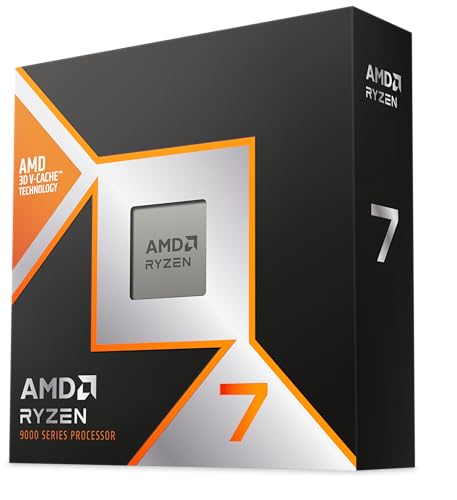
| 8 AMD Ryzen 7 9800X3D 8-Core Processor | AMD | 1.97 × 1.97 × 0.04 in | 0.2 lb | 96MB L3 cache | Check price |
| 9 HP Omen Max 45L RTX 5070 Ti | Empowered PC | Not listed | 50 lb | RTX 5070 Ti with 16GB GDDR7 | Check price |
Sizes and weights as listed by the manufacturer on Amazon. Check the retailer for current price and availability.
Pros
- Eight cores and 16 threads
- 100 MB cache
- DDR4-3200 support
- PCIe 4.0 support on X570 and B550
Cons
- Cooler not included; high-performance cooler recommended
- Who should skip it: builders not using Socket AM4
Pros
- 16-core desktop processor
- Up to 5.7 GHz boost clock
- AM5 platform
Cons
- Who should skip it: buyers looking for a laptop processor
Pros
- Eight cores and 16 threads
- 96 MB L3 cache
- Integrated AMD Radeon Graphics controller
Cons
- Who should skip it: users needing more than eight CPU cores

Pros
- 8 cores and 16 threads
- Unlocked for overclocking
- DDR4-3200 support
Cons
- Cooler not included
- Requires a discrete graphics card
- Who should skip it: builders seeking a processor with integrated graphics

Pros
- Six cores and 12 threads
- Unlocked for overclocking
- DDR5-5600 support
Cons
- Cooler is not included
- Who should skip it: owners of non-AM5 motherboards

Pros
- 12 cores and 24 threads
- Unlocked for overclocking
- 76 MB cache
- DDR5-5600 support
Cons
- Who should skip it: builders needing a bundled cooler

Pros
- Six cores and 12 processing threads
- Wraith Stealth cooler included
- Unlocked for overclocking
Cons
- Who should skip it: builders without a discrete graphics card
Pros
- 96MB L3 cache
- Socket AM5 compatibility
- Up to 5.2GHz stated clock speed
Cons
- Who should skip it: buyers who need an included cooler

Pros
- RTX 5070 Ti with 16GB GDDR7
- 32GB DDR5 memory
- 2TB Gen4 NVMe SSD
- Three USB-C ports
Cons
- Who should skip it: buyers needing documented performance targets beyond 1080p
Gaming-Focused AM5 Pick: AMD Ryzen 7 9800X3D 8-Core Processor
AMD Ryzen 7 9800X3D 8-Core Processor pairs 8 cores and 16 threads with 96MB of L3 cache and AMD’s next-generation 3D V-Cache. Its AM5 socket and Zen 5 architecture make it a potential fit for a new DDR5 build where gaming is the priority.
The trade-off is that it has fewer cores than the Ryzen 9 options, and the listing says a cooler is not included. Skip it if you need more CPU cores for heavily parallel work or want to keep an AM4 motherboard.
Gaming and Creation Pick: AMD Ryzen 9 9950X3D 16-Core Processor
AMD Ryzen 9 9950X3D 16-Core Processor combines 16 cores with Zen 5 and 3D V-Cache, making it the most core-heavy X3D processor in this selection. Its listed boost clock reaches up to 5.7 GHz, a useful specification to consider alongside demanding gaming and content-creation workloads.
The product details do not state memory support or cooler inclusion, so confirm both before planning the build. Skip it if your main goal is gaming and you would rather prioritize a lower-core-count processor or an AM4 upgrade.
AM4 Upgrade Pick: AMD Ryzen 7 5800X3D 8-Core Processor
AMD Ryzen 7 5800X3D 8-Core Processor is an AM4 processor with 8 cores, 16 threads, 100MB of cache, and DDR4-3200 support. It can suit an existing AM4 system if the motherboard and BIOS support it, avoiding an automatic move to an AM5 board and DDR5 memory.
Its platform is older than the AM5 choices, and the listing recommends a high-performance cooler but does not include one. Skip it if you are building new and want an AM5 system with a longer-term platform upgrade path.
Key Numbers at a Glance
- Core counts span 6 cores on the AMD Ryzen 5 9600X 6-Core Processor to 16 cores on the AMD Ryzen 9 9950X3D 16-Core Processor.
- The AMD Ryzen 7 5800X3D 8-Core Processor lists 100MB of cache, while the AMD Ryzen 7 7800X3D, 8-Core CPU lists 96MB of L3 cache.
- The AMD Ryzen 9 9950X3D 16-Core Processor lists a maximum boost clock of up to 5.7 GHz; the AMD Ryzen 7 9800X3D 8-Core Processor lists up to 5.2 GHz.
- The AMD Ryzen 5 5500 6-Core Processor supports DDR4-3200, while the AMD Ryzen 5 9600X 6-Core Processor supports DDR5-5600.
How to Choose a CPU for an RTX 5070 Ti
Start with your motherboard and memory
Bottom line: Match the CPU socket and memory type to your existing parts before comparing clock speeds. The Ryzen 7 5800X3D and Ryzen 7 5700X use AM4 and support DDR4-3200; the Ryzen 9 9900X and Ryzen 5 9600X use AM5 and support DDR5-5600. AM4 and AM5 are different platforms, so an AM4 processor is not a drop-in replacement for an AM5 motherboard.
If you are reusing a board, check its manufacturer CPU support list and BIOS requirements. If you are building new, include the compatible motherboard and memory in your budget rather than comparing CPU prices alone.
Choose gaming cache or additional cores for your workload
Bottom line: Consider an X3D chip for a gaming-focused build, and compare core counts for work that can use more threads. The Ryzen 7 7800X3D lists 8 cores, 16 threads, and 96MB of L3 cache; the Ryzen 9 9900X has 12 cores and 24 threads, while the Ryzen 9 9950X3D has 16 cores. More cores alone do not guarantee higher gaming performance, so match the CPU to the games and applications you actually use.
For a wider GPU comparison, see our guides to best CPUs for RTX 5070 and best CPUs for RTX 5080. The RTX 5070 Ti build’s resolution and target frame rate also affect how much CPU performance matters in practice.
Balance core count with your creative workload
Bottom line: For CPU-heavy editing or rendering, compare core counts and the application’s requirements rather than selecting on gaming claims alone. The Ryzen 9 9950X3D lists 16 cores and 32 threads, while the Ryzen 9 9900X lists 12 cores and 24 threads. Those specifications make them candidates to assess for threaded workloads, but product data alone does not establish how quickly a particular project will finish.
The Ryzen 7 9700X appears in the Empowered PC HP 0men Max 45L RTX 5070 Ti desktop listing with 8 cores and 16 threads. If you are considering a complete system rather than a separate CPU, compare its included components and connectivity with your current PC before deciding.
Account for cooling and power planning
Bottom line: Confirm cooler inclusion and your cooling plan before ordering a processor. The Ryzen 5 5500 includes an AMD Wraith Stealth cooler, but the Ryzen 7 7800X3D and Ryzen 9 9900X listings say a cooler is not included. The Ryzen 7 5800X3D listing recommends a high-performance cooler and also says one is not included.
These details do not establish the cooler needed for every case or workload. Check the processor manufacturer’s current cooling guidance, your case clearance, and the rest of your system’s power requirements before assembly.
Consider whether a lower-cost platform upgrade meets your goal
Bottom line: An AM4 CPU can be a more practical upgrade when you already have compatible AM4 parts, while a new build can weigh AM5 features against total platform cost. The Ryzen 7 5700X lists 8 cores, 16 threads, and DDR4-3200 support; the Ryzen 5 5500 is a 6-core AM4 choice with a bundled cooler. Both require an AM4 motherboard, and the Ryzen 5 5500 product details identify a discrete graphics card as required.
For other GPU pairings, compare our guides to best CPUs for RTX 5090 and PC processors. Check the motherboard, BIOS, cooler, and memory details for the exact parts in your system.
How We Compared These Products
This guide is based on product research, not firsthand evaluation. We compared the listed core and thread counts, cache, boost clocks, socket and memory details, cooler information, and stated platform features; where a product page omits a specification, we recommend checking it with the manufacturer before buying.
Which Option Fits Your Build?
If you are gaming on a new AM5 system, the Ryzen 7 9800X3D is the gaming-focused pick here, while the Ryzen 9 9950X3D is worth assessing if your work also benefits from its 16 cores. For an existing AM4 PC, the Ryzen 7 5800X3D or Ryzen 7 5700X may fit more naturally, provided your board supports the chosen CPU.
Mistakes to Avoid When Choosing a CPU for an RTX 5070 Ti
- Buying by model number alone. Compare the actual socket, memory support, core count, and cache instead of assuming a higher number suits every workload.
- Forgetting platform costs. Moving from AM4 to AM5 requires a compatible AM5 motherboard and DDR5 memory, so account for those parts when planning a new build.
- Assuming every CPU includes a cooler. Check the exact listing: several processors here exclude a cooler, while the Ryzen 5 5500 includes a Wraith Stealth cooler.
- Choosing only by core count for gaming. Compare the games and frame-rate goals you care about, and weigh the X3D models’ cache alongside core count rather than treating more cores as an automatic gaming advantage.
Frequently Asked Questions
Do these CPUs work with an RTX 5070 Ti?
These are desktop processors, and the product data does not identify a specific RTX 5070 Ti compatibility restriction. Choose a CPU and motherboard combination that supports each other, then confirm the graphics card fits your case and works with your power supply.
Can I use an AM4 CPU in an AM5 motherboard?
No. The Ryzen 7 5800X3D, Ryzen 7 5700X, and Ryzen 5 5500 are AM4 processors; the Ryzen 9 9900X and Ryzen 5 9600X are AM5 processors. Match the socket and confirm the motherboard’s CPU support before purchase.
Is the Ryzen 7 5800X3D or Ryzen 7 7800X3D a better upgrade?
The Ryzen 7 5800X3D is the AM4 choice and supports DDR4-3200, making it relevant to a compatible existing AM4 build. The Ryzen 7 7800X3D is an AM5 processor, so it belongs in a different platform plan; choose based on your motherboard and memory, not the model names alone.
Which CPU has the most cores in this comparison?
The Ryzen 9 9950X3D lists 16 cores and 32 threads, the highest core count among these processors. That makes it a candidate for workloads that benefit from additional CPU cores, but it does not establish a particular gaming or rendering result.
Do these processors include a cooler?
The Ryzen 5 5500 listing includes an AMD Wraith Stealth cooler. The Ryzen 7 5800X3D listing says a cooler is not included and recommends a high-performance cooler; several other product listings also state that a cooler is not included, so check the exact product details.


Write Your Review
No reviews yet. Be the first to share your experience!