


Building around an Intel Arc B580, or upgrading an existing PC, means choosing a CPU that fits your motherboard without overspending on processing power you may not use. There is no single processor made specifically for this graphics card: the AMD Ryzen 5 9600X is a sensible starting point for a newer AM5 gaming build, while the AMD Ryzen 5 5500 suits a lower-cost AM4 upgrade if your board supports it.
This guide to the best cpu for arc b580 compares socket and memory requirements, gaming-focused cache, core counts, and upgrade trade-offs. Check your motherboard and intended workload before choosing; a CPU upgrade can require a new board or memory as well.
Compare at a glance
| Product | Brand | Size | Weight | Stands out for | Price |
|---|---|---|---|---|---|
| 1 AMD Ryzen 7 5800X3D 8-Core Processor | AMD | 1.57 × 1.57 × 0.1 in | 0.2 lb | Eight cores and 16 threads | Check price |
| 2 AMD Ryzen 9 9950X3D 16-Core Processor | AMD | 1.6 × 1.6 × 0.1 in | 0.2 lb | 16-core desktop processor | Check price |
| 3 AMD Ryzen 7 7800X3D, 8-Core CPU | AMD | 5.12 × 3.58 × 5.08 in | 0.7 lb | Eight cores and 16 threads | Check price |
| 4 AMD Ryzen 7 5700X 8-Core Processor | AMD | 1.57 × 1.57 × 0.24 in | 0.3 lb | 8 cores and 16 threads | Check price |
| 5 AMD Ryzen 5 9600X 6-Core Processor | AMD | 1.57 × 1.57 × 0.04 in | 0.2 lb | Six cores and 12 threads | Check price |
| 6 AMD Ryzen 9 9900X 12-Core Processor | AMD | 1.97 × 1.97 × 0.04 in | 0.2 lb | 12 cores and 24 threads | Check price |
| 7 AMD Ryzen 5 5500 6-Core Processor | AMD | 1.57 × 1.57 × 0.24 in | 1 lb | Six cores and 12 processing threads | Check price |
| 8 AMD Ryzen 7 9800X3D 8-Core Processor | AMD | 1.97 × 1.97 × 0.04 in | 0.2 lb | 96MB L3 cache | Check price |
Sizes and weights as listed by the manufacturer on Amazon. Check the retailer for current price and availability.
Pros
- Eight cores and 16 threads
- 100 MB cache
- DDR4-3200 support
- PCIe 4.0 support on X570 and B550
Cons
- Cooler not included; high-performance cooler recommended
- Who should skip it: builders not using Socket AM4
Pros
- 16-core desktop processor
- Up to 5.7 GHz boost clock
- AM5 platform
Cons
- Who should skip it: buyers looking for a laptop processor
Pros
- Eight cores and 16 threads
- 96 MB L3 cache
- Integrated AMD Radeon Graphics controller
Cons
- Who should skip it: users needing more than eight CPU cores
Best for an AM4 system you want to keep

Pros
- 8 cores and 16 threads
- Unlocked for overclocking
- DDR4-3200 support
Cons
- Cooler not included
- Requires a discrete graphics card
- Who should skip it: builders seeking a processor with integrated graphics
Best for a new AM5 gaming build

Pros
- Six cores and 12 threads
- Unlocked for overclocking
- DDR5-5600 support
Cons
- Cooler is not included
- Who should skip it: owners of non-AM5 motherboards

Pros
- 12 cores and 24 threads
- Unlocked for overclocking
- 76 MB cache
- DDR5-5600 support
Cons
- Who should skip it: builders needing a bundled cooler

Pros
- Six cores and 12 processing threads
- Wraith Stealth cooler included
- Unlocked for overclocking
Cons
- Who should skip it: builders without a discrete graphics card
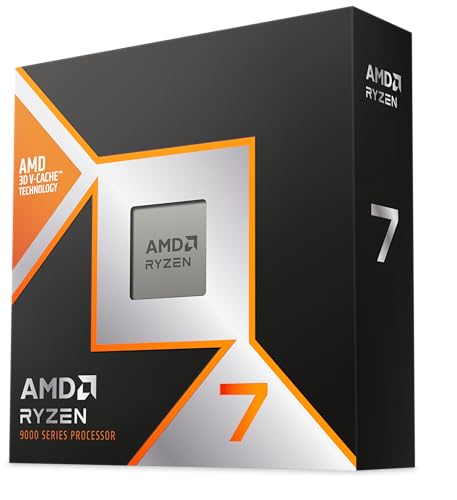
Pros
- 96MB L3 cache
- Socket AM5 compatibility
- Up to 5.2GHz stated clock speed
Cons
- Who should skip it: buyers who need an included cooler
Best Budget AM4 CPU: AMD Ryzen 5 5500 6-Core Processor
AMD Ryzen 5 5500 6-Core Processor stands out for an AM4 build where keeping the existing platform matters: it has 6 cores, 12 threads, DDR4-3200 support, and a bundled Wraith Stealth cooler. Its 19 MB cache is less than the 36 MB listed for the AMD Ryzen 7 5700X, and the product page calls for a discrete graphics card. Skip it if you are building on AM5 or want more cache and cores for heavier CPU-side workloads.
Best AM5 Gaming Starting Point: AMD Ryzen 5 9600X 6-Core Processor
AMD Ryzen 5 9600X 6-Core Processor combines 6 cores and 12 threads with Zen 5 architecture, DDR5-5600 support, and a stated 5.4 GHz maximum boost clock. That makes it a straightforward fit to consider for a new AM5 gaming build, though the product page says a cooler is not included. Skip it if you need an AM4 drop-in upgrade or prioritize more cores for parallel creative work.
Best for Gaming Cache: AMD Ryzen 7 7800X3D, 8-Core CPU
AMD Ryzen 7 7800X3D, 8-Core CPU is an AM5 option with 8 cores, 96 MB of L3 cache, and a listed 2200 MHz graphics frequency. Its larger cache and two additional cores compared with the Ryzen 5 9600X may appeal if gaming is the priority, but those specifications alone do not guarantee a particular Arc B580 frame rate. Skip it if you need to reuse an AM4 motherboard or want a lower-cost processor for a basic gaming build.
Key Numbers at a Glance
- The AMD Ryzen 5 5500 has 6 cores and 12 threads; the AMD Ryzen 7 5700X has 8 cores and 16 threads.
- The AMD Ryzen 5 9600X lists 38 MB of cache, while the AMD Ryzen 7 7800X3D lists 96 MB of L3 cache.
- The AMD Ryzen 9 9950X3D lists 16 cores and a maximum boost clock of up to 5.7 GHz.
- The Intel Core Ultra 5 processor 250K is listed with 18 cores: 6 P-cores and 12 E-cores.
How to Choose the Best CPU for Arc B580
Start with motherboard socket and memory
Bottom line: Match the processor to your existing motherboard first, because the listed AMD CPUs do not all use the same socket or memory generation. The Ryzen 5 5500 and Ryzen 7 5700X are AM4 processors with DDR4-3200 support, while the Ryzen 5 9600X lists AM5 and DDR5-5600 support. The Intel Core Ultra 5 processor 250K uses LGA1851 and requires an Intel 800 Series chipset motherboard, with DDR5 support specified.
For an upgrade, identify your exact motherboard model and check its CPU support list and BIOS requirements before buying. A move from AM4 to AM5 or LGA1851 involves a different socket, and the memory requirements can also mean replacing existing RAM.
If you are comparing processor pairings for a different graphics card, see our guides to best CPUs for RTX 5070 and best CPUs for RTX 5080. Those guides address other GPU pairings, but the same socket-first approach applies.
Balance gaming needs against core count and cache
Bottom line: Choose a gaming-focused CPU for games first, and pay for extra cores when your non-gaming workload can use them. The Ryzen 7 7800X3D lists 8 cores and 96 MB of L3 cache, while the 6-core Ryzen 5 9600X lists 38 MB of cache. The 12-core Ryzen 9 9900X offers 24 threads and may be a more relevant fit when gaming shares the PC with heavily threaded work.
These figures describe different CPU features, not measured Arc B580 performance. Game choice, resolution, settings, and background tasks affect the balance, so look for benchmarks of the exact CPU and game combination before paying extra for a higher core count or cache.
Match platform cost to your upgrade plan
Bottom line: Keeping a compatible AM4 motherboard can make an AM4 processor the simpler upgrade, while a new build should account for the full platform change. The Ryzen 7 5700X is an 8-core, 16-thread AM4 CPU with DDR4-3200 support; the Ryzen 5 9600X is a 6-core, 12-thread AM5 option with DDR5-5600 support. The Intel Core Ultra 5 processor 250K instead requires LGA1851 and an Intel 800 Series chipset board.
Compare the cost and compatibility of the CPU, motherboard, and memory together rather than treating the processor as a standalone purchase. For another GPU-focused comparison, see best CPUs for RTX 5090.
Account for cooling and power needs
Bottom line: Check cooler inclusion and the motherboard’s power support instead of assuming every processor comes ready to install. The Ryzen 5 5500 includes a Wraith Stealth cooler, while the Ryzen 5 9600X, Ryzen 7 7800X3D, and Ryzen 7 5700X listings state that a cooler is not included. The Intel Core Ultra 5 processor 250K lists 125 W base power and 250 W maximum turbo power.
Confirm the exact cooler requirements and case compatibility with the CPU and motherboard manufacturers. The available product details do not establish a cooler recommendation for every processor or say that a cooler is included unless noted above.
How We Compared These Products
This guide is based on product research, not firsthand evaluation. We compared the listed core and thread counts, cache, clock specifications, socket and memory support, cooler details, and available customer feedback; those details do not establish frame rates with an Arc B580. Where a listing does not give enough information to confirm a feature, check the processor and motherboard manufacturer’s documentation before buying.
Which Option Fits Your Build?
For an AM4 system you want to keep: AMD Ryzen 7 5700X 8-Core Processor offers 8 cores and 16 threads with DDR4-3200 support. Skip it if your motherboard is not AM4 or you are planning an AM5 or LGA1851 build.
For a new AM5 gaming build: AMD Ryzen 5 9600X 6-Core Processor combines 6 cores and 12 threads with DDR5-5600 support and a stated 5.4 GHz maximum boost clock. Skip it if you need a bundled cooler or want more than 6 CPU cores.
For gaming where cache is a priority: AMD Ryzen 7 7800X3D, 8-Core CPU lists 8 cores and 96 MB of L3 cache on AM5. Skip it if you are keeping an AM4 board or need to prioritize a lower-cost platform over the X3D cache feature.
Mistakes to Avoid When Choosing a CPU for Arc B580
- Choosing by model name alone. Verify the exact socket and motherboard CPU support list; AM4, AM5, and LGA1851 are different platforms.
- Assuming a CPU guarantees a frame rate. Compare benchmarks for your games, resolution, and graphics settings rather than treating core count or boost clock as a frame-rate promise.
- Forgetting memory requirements. Check whether the chosen platform uses the DDR4 or DDR5 memory supported by the listed processor, and include any required memory change in your plan.
- Overlooking the cooler. Check the product listing and manufacturer guidance; some listed CPUs do not include a cooler, while the Ryzen 5 5500 includes a Wraith Stealth cooler.
Frequently Asked Questions
Is there a CPU made specifically for the Arc B580?
The listed processors are general desktop CPUs, not models designated specifically for the Arc B580. Choose based on your motherboard, games, other workloads, and budget for the complete platform.
Can I use an AM4 CPU with an AM5 motherboard?
No. AM4 and AM5 are different CPU sockets, so an AM4 processor such as the Ryzen 5 5500 is not an AM5 CPU. Check the motherboard’s supported processor list before ordering.
Should I choose the Ryzen 5 9600X or Ryzen 7 7800X3D?
The Ryzen 5 9600X has 6 cores, 12 threads, and DDR5-5600 support; the Ryzen 7 7800X3D has 8 cores and 96 MB of L3 cache. Consider the 9600X for a 6-core AM5 build and the 7800X3D if its additional cores and listed cache align with your gaming priorities, then compare game-specific benchmarks.
Does the Ryzen 5 5500 include a cooler?
Yes. Its product details specify a Wraith Stealth cooler. Check the listing for the exact item you purchase, and confirm that the cooler and case suit your build.
Do all these processors support the same memory?
No. The Ryzen 5 5500 and Ryzen 7 5700X specify DDR4-3200, while the Ryzen 5 9600X specifies DDR5-5600. The Intel Core Ultra 5 processor 250K is listed for DDR5, so verify memory type and motherboard support before reusing RAM.


Write Your Review
No reviews yet. Be the first to share your experience!