


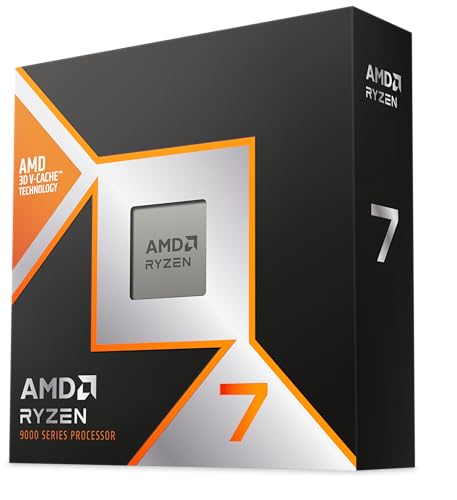

If you are pairing an RTX 5080 with a processor, the right choice depends on whether you prioritize gaming, CPU-heavy creation, or reusing an older AM4 motherboard. The Ryzen 7 9800X3D is the gaming-focused AM5 choice in this lineup, while the Ryzen 9 9950X3D adds 16 cores for mixed workloads; AM4 owners should check the Ryzen 7 5800X3D and motherboard support before replacing a whole platform.
This guide to the best CPUs for RTX 5080 also includes complete desktops, so check whether you want a processor for an existing build or a ready-made system. Socket, memory type, cooling, and power supply compatibility matter as much as the CPU name.
Compare at a glance
| Product | Brand | Size | Weight | Stands out for | Price |
|---|---|---|---|---|---|
| 1 AMD Ryzen 5 9600X 6-Core Processor | AMD | 1.57 × 1.57 × 0.04 in | 0.2 lb | Six cores and 12 threads | Check price |
| 2 AMD Ryzen 7 5800X3D 8-Core Processor | AMD | 1.57 × 1.57 × 0.1 in | 0.2 lb | Eight cores and 16 threads | Check price |
| 3 AMD Ryzen 7 9800X3D 8-Core Processor | AMD | 1.97 × 1.97 × 0.04 in | 0.2 lb | 96MB L3 cache | Check price |
| 4 STORMCRAFT Phantom RTX 5080 Gaming PC | STORMCRAFT | 18.5 × 9 × 16.9 in | Not listed | RTX 5080 with 16GB of GDDR7 | Check price |
| 5 AMD Ryzen 7 5700X 8-Core Processor | AMD | 1.57 × 1.57 × 0.24 in | 0.3 lb | 8 cores and 16 threads | Check price |
| 6 AMD Ryzen 9 9950X3D 16-Core Processor | AMD | 1.6 × 1.6 × 0.1 in | 0.2 lb | 16-core desktop processor | Check price |
| 7 MSI Aegis ZS2 Gaming Desktop, RTX 5080 | msi | 24 × 23 × 13 in | 41 lb | Ryzen 9 9900X processor | Check price |
| 8 HP Omen Max 45L RTX 5080 Gaming PC | Empowered PC | Not listed | 50 lb | RTX 5080 with 16GB GDDR7 | Check price |
| 9 Empowered PC Panorama RTX 5080 Desktop | Empowered PC | 15.2 × 10.6 × 14.9 in | 30 lb | RTX 5080 with 16GB GDDR7 | Check price |
| 10 MSI Aegis ZS2, Ryzen 9 9900X | msi | 24 × 23 × 13 in | 41 lb | RTX 5080 with 16GB GDDR7 | Check price |
Sizes and weights as listed by the manufacturer on Amazon. Check the retailer for current price and availability.
Pros
- Six cores and 12 threads
- Unlocked for overclocking
- DDR5-5600 support
Cons
- Cooler is not included
- Who should skip it: owners of non-AM5 motherboards
Pros
- Eight cores and 16 threads
- 100 MB cache
- DDR4-3200 support
- PCIe 4.0 support on X570 and B550
Cons
- Cooler not included; high-performance cooler recommended
- Who should skip it: builders not using Socket AM4
Pros
- 96MB L3 cache
- Socket AM5 compatibility
- Up to 5.2GHz stated clock speed
Cons
- Who should skip it: buyers who need an included cooler

Pros
- RTX 5080 with 16GB of GDDR7
- 32GB DDR5-6000 memory
- 2TB NVMe Gen4 SSD
- Three-year labor warranty
Cons
- Who should skip it: buyers needing a smaller-form-factor system

Pros
- 8 cores and 16 threads
- Unlocked for overclocking
- DDR4-3200 support
Cons
- Cooler not included
- Requires a discrete graphics card
- Who should skip it: builders seeking a processor with integrated graphics

Pros
- 16-core desktop processor
- Up to 5.7 GHz boost clock
- AM5 platform
Cons
- Who should skip it: buyers looking for a laptop processor

Pros
- Ryzen 9 9900X processor
- RTX 5080 with 16GB GDDR7
- Liquid cooling included
- Windows 11 Pro included
Cons
- Who should skip it: buyers who need more than 16GB of RAM out of the box

Pros
- RTX 5080 with 16GB GDDR7
- 2TB Gen4 NVMe SSD
- Windows 11 Pro
- Wired RGB keyboard and mouse included
Cons
- Who should skip it: buyers needing a lightweight PC

Pros
- RTX 5080 with 16GB GDDR7
- 64GB DDR4 memory
- 2TB Gen4 NVMe SSD
- Three-year limited hardware warranty
Cons
- Additional video ports may vary
- Who should skip it: buyers who need confirmed additional video outputs
Pros
- RTX 5080 with 16GB GDDR7
- 64GB DDR5 memory
- 4TB internal PCIe SSD
- Windows 11 Pro included
Cons
- Who should skip it: buyers seeking a warranty longer than one year
Best for Gaming on AM5: AMD Ryzen 7 9800X3D 8-Core Processor
AMD Ryzen 7 9800X3D 8-Core Processor fits a gaming-focused AM5 build with 8 cores, 16 threads, and 96MB of L3 cache. It has a listed boost clock up to 5.2GHz and uses AMD 3D V-Cache, a feature aimed at gaming workloads. The processor does not include a cooler, so factor in a compatible cooling solution.
Skip it if you need more than 8 CPU cores for heavily parallel work or want to retain an AM4 motherboard.
Best for Gaming and Creation: AMD Ryzen 9 9950X3D 16-Core Processor
AMD Ryzen 9 9950X3D 16-Core Processor combines 16 cores with AMD 3D V-Cache, making it a candidate for a PC that handles gaming and demanding creation tasks. Its stated maximum boost clock is 5.7GHz, but the product data does not specify its cache capacity or included cooling hardware.
Skip it if your main goal is gaming and you would rather prioritize a less complex, lower-core-count CPU.
Best for a Lower-Cost AM5 Build: AMD Ryzen 5 9600X 6-Core Processor
AMD Ryzen 5 9600X 6-Core Processor offers 6 cores, 12 threads, and a stated boost clock up to 5.4GHz on the AM5 platform. It supports DDR5-5600 and can support PCIe 5.0 on select motherboards, giving you an AM5 foundation without moving to a 12- or 16-core chip.
Skip it if your regular workload benefits from more CPU cores, or if your current motherboard only supports AM4.
Best for an AM4 Gaming Upgrade: AMD Ryzen 7 5800X3D 8-Core Processor
AMD Ryzen 7 5800X3D 8-Core Processor is an 8-core, 16-thread AM4 processor with 100MB of cache and DDR4-3200 support. It can support PCIe 4.0 on X570 and B550 motherboards, which makes it worth checking for an existing AM4 build before budgeting for a new motherboard and memory.
Skip it if you are building on AM5 or your motherboard does not support the chip. Confirm CPU support with the board maker before ordering.
Best Ready-Made Gaming Pairing: STORMCRAFT Phantom RTX 5080 Gaming PC
STORMCRAFT Phantom RTX 5080 Gaming PC pairs the RTX 5080 with a Ryzen 7 9800X3D, 32GB of DDR5-6000 memory, and a 2TB NVMe Gen4 SSD. The listing also specifies a 360mm AIO cooler and an 850W Gold-certified power supply, but buyers should verify the exact component models and upgrade options before purchase.
Skip it if you already own a compatible system and only need a CPU, or if you want to select every component yourself.
Key Numbers at a Glance
- The Ryzen 5 9600X lists 6 cores and 12 threads, compared with 16 cores and 32 threads for the Ryzen 9 9950X3D.
- The Ryzen 7 5800X3D lists 100MB of cache; the Ryzen 7 9800X3D lists 96MB of L3 cache. These figures describe different cache categories, so do not treat them as directly interchangeable.
- The Ryzen 5 9600X supports DDR5-5600, while the Ryzen 7 5700X supports DDR4-3200.
- The STORMCRAFT Phantom RTX 5080 Gaming PC lists 32GB DDR5-6000 memory, a 2TB NVMe Gen4 SSD, and an 850W Gold-certified power supply.
How to Choose a CPU for an RTX 5080
Gaming focus versus core count
Bottom line: For a gaming-first build, compare cache-focused models before paying for extra cores. The Ryzen 7 9800X3D has 8 cores, 16 threads, and 96MB of L3 cache; the Ryzen 9 9950X3D has 16 cores, 32 threads, and a stated boost up to 5.7GHz. More cores can suit workloads that use them, but core count alone does not establish gaming performance. Choose based on the games and non-gaming applications you actually run, and consult independent benchmarks for those specific workloads.
Socket, motherboard, and memory generation
Bottom line: Match the processor socket and memory type to your motherboard before comparing clocks. The Ryzen 5 9600X and Ryzen 7 9800X3D use AM5 and DDR5, while the Ryzen 7 5800X3D and Ryzen 7 5700X use AM4 and DDR4. An AM4 owner considering the 5800X3D should verify motherboard BIOS support; moving to AM5 can also mean budgeting for a compatible board and DDR5 memory.
If you are exploring other parts for a new build, our PC components section offers related buying guides. For an existing AM4 system, check the motherboard maker’s CPU support list rather than assuming every AM4 board accepts every processor.
Resolution, refresh rate, and the games you play
Bottom line: Choose around your display and target workloads, not the RTX 5080 name alone. A high-resolution gaming setup and a high-refresh-rate competitive setup can put different emphasis on the GPU and CPU. The product listings do not include comparative benchmark results, so use independent results for your resolution, games, and graphics settings before spending extra on a higher-tier processor.
Cooling, power, and build fit
Bottom line: Confirm the cooler and power supply as part of the complete build, since retail CPUs here do not include a cooler. The Ryzen 5 9600X, Ryzen 7 5800X3D, Ryzen 7 5700X, and Ryzen 7 9800X3D listings state that a cooler is not included. The STORMCRAFT desktop lists a 360mm AIO and 850W Gold-certified PSU; those are system specifications, not guaranteed specifications for a separate CPU purchase.
Check your case’s cooler and radiator support, motherboard socket, and power supply requirements before ordering. For broader PSU selection, compare our guides to best power supplies for gaming PCs and best power supplies for RTX 5090, while confirming the needs of your specific RTX 5080 card.
CPU-only upgrade or complete desktop
Bottom line: Buy a standalone processor only when you have checked the rest of your platform. A CPU upgrade depends on socket, board support, memory type, cooler fit, and the existing power supply. A complete desktop such as the STORMCRAFT Phantom RTX 5080 Gaming PC bundles the CPU, GPU, memory, storage, cooling, and PSU, but gives you less control over the exact components than a self-built system.
How We Compared These Products
This guide is based on product research, including the listed CPU socket, core and thread counts, cache, clock specifications, memory support, and the system components stated for complete desktops. The product pages do not establish comparative benchmark results, and customer feedback does not provide a basis here for ranking performance. We did not evaluate these products firsthand.
Which Option Fits Your Build?
For a gaming-focused AM5 build, start with the AMD Ryzen 7 9800X3D 8-Core Processor; for gaming plus CPU-heavy creation, compare the 16-core AMD Ryzen 9 9950X3D 16-Core Processor. Skip either if your existing system requires AM4, and verify the full platform cost before moving sockets.
For an existing AM4 system, check whether your board supports the AMD Ryzen 7 5800X3D 8-Core Processor before considering a platform change. Skip it if you want a new AM5 build or cannot confirm board support; the Ryzen 5 9600X is an AM5 alternative, but requires a compatible AM5 board and DDR5 memory.
For a bundled system, the STORMCRAFT Phantom RTX 5080 Gaming PC lists a Ryzen 7 9800X3D, 32GB of DDR5-6000, and 2TB of SSD storage. Skip it if you only need a processor or want to choose the desktop’s individual parts.
Mistakes to Avoid When Choosing a CPU for RTX 5080
- Buying by model number alone. Compare socket, core count, cache, and memory support, then check workload-specific benchmarks rather than assuming a higher model number fits every game.
- Overlooking the platform cost. An AM4 processor and an AM5 processor use different sockets and memory generations; confirm whether your board and RAM can stay in the build.
- Assuming the CPU includes a cooler. Several standalone listings explicitly exclude one, so check the product page and case compatibility before planning the build.
- Confusing a prebuilt’s specifications with a CPU’s specifications. A desktop’s listed PSU, memory, and cooling belong to that system; do not assume they come with a standalone processor.
Frequently Asked Questions
Which CPU pairs well with an RTX 5080 for gaming?
The Ryzen 7 9800X3D is the gaming-focused AM5 choice here, with 8 cores, 16 threads, and 96MB of L3 cache. The listing does not provide comparative frame-rate results, so check independent benchmarks for the games and resolution you use.
Is the Ryzen 7 5800X3D compatible with every AM4 motherboard?
No universal motherboard compatibility is stated. The processor uses AM4 and can support PCIe 4.0 on X570 and B550 boards, but you should confirm CPU and BIOS support for your exact motherboard model.
Should I choose the Ryzen 7 9800X3D or Ryzen 9 9950X3D?
Choose the Ryzen 7 9800X3D if your priority is a gaming-focused 8-core AM5 CPU; consider the Ryzen 9 9950X3D if your workload can use 16 cores as well as gaming features. The listings do not include direct benchmarks, so compare results for your software before deciding.
Can I use DDR4 memory with an AM5 processor?
The Ryzen 5 9600X listing specifies DDR5-5600, while the Ryzen 7 5800X3D and Ryzen 7 5700X specify DDR4-3200. Match memory to the processor and motherboard platform rather than expecting a memory kit to work across both platforms.
Do these standalone CPUs include a cooler?
The listings for the Ryzen 5 9600X, Ryzen 7 5800X3D, Ryzen 7 5700X, and Ryzen 7 9800X3D say a cooler is not included. Check the specific product listing for the Ryzen 9 9950X3D and choose a compatible cooler for your processor and case.
Is an RTX 5080 desktop easier than upgrading my current PC?
A complete desktop bundles the processor, graphics card, memory, storage, cooling, and power supply, which avoids selecting each component separately. An upgrade can make more sense if your current motherboard, memory, cooler, and PSU support the parts you plan to install; check each component’s compatibility first.


Write Your Review
No reviews yet. Be the first to share your experience!