


For a small business protecting a workstation and network gear, a 1500VA model with AVR can offer more wattage and voltage correction than a compact standby unit; a router-only setup can need far less. This guide to the best ups battery backup for small business compares rated output, outlet layout, monitoring, and battery features so you can match the UPS to your actual load and shutdown needs.
Compare at a glance
| Product | Brand | Size | Weight | Stands out for | Price |
|---|---|---|---|---|---|
| 1 Amazon Basics UPS, 800VA/450W | Amazon Basics | 12.2 × 7 × 3.14 in | 9.4 lb | 12 total outlets | Check price |
| 2 CyberPower ST425 425VA UPS | CyberPower | 3.2 × 8.3 × 4.5 in | 3.8 lb | Battery backup and surge protection on four outlets | Check price |
| 3 APC BE650G1 UPS Battery Backup | APC | 7.09 × 11.18 × 3.39 in | 14 lb | Eight outlets across backup and surge-only groups | Check price |
| 4 CyberPower EC850LCD 850VA UPS | CyberPower | 12.2 × 7 × 3.1 in | 7.7 lb | Multifunction LCD panel | Check price |
| 5 APC BX1500M 1500VA UPS | APC | 15.04 × 3.94 × 9.84 in | 24 lb | 1500VA/900W capacity | Check price |
| 6 APC BE600M1 600VA UPS | APC | 10.79 × 4.13 × 5.47 in | 7.5 lb | Five battery-backed outlets | Check price |
| 7 CyberPower CP1500PFCLCD 1500VA UPS | CyberPower | 14 × 3.9 × 11 in | 25 lb | Sinewave output for active PFC power supplies | Check price |
| 8 GOLDENMATE 1500VA/1000W LiFePO4 UPS | GOLDENMATE | 3.54 × 9.84 × 13 in | 14 lb | Eight battery-backed outlets | Check price |
Sizes and weights as listed by the manufacturer on Amazon. Check the retailer for current price and availability.
Pros
- 12 total outlets
- Six battery-backup outlets
- Compact dimensions
- 5-foot power cord
Cons
- Who should skip it: users needing extended backup time
Pros
- Battery backup and surge protection on four outlets
- Four additional surge-protected outlets
- Three-year warranty includes the battery
Cons
- Who should skip it: users whose equipment exceeds 260W
Pros
- Eight outlets across backup and surge-only groups
- User-replaceable battery
- RJ45 Ethernet surge protection
Cons
- Who should skip it: users needing over four battery-backed outlets

Pros
- Multifunction LCD panel
- 12 total outlets
- Three-year warranty includes battery
- ECO-controlled outlets
Cons
- Only six outlets provide battery backup
- Who should skip it: users needing more than 510W

Pros
- 1500VA/900W capacity
- AVR voltage regulation
- LCD status display
- User-replaceable battery
- UL certified
Cons
- Only five outlets provide battery backup
- Who should skip it: users needing battery backup for more than five devices
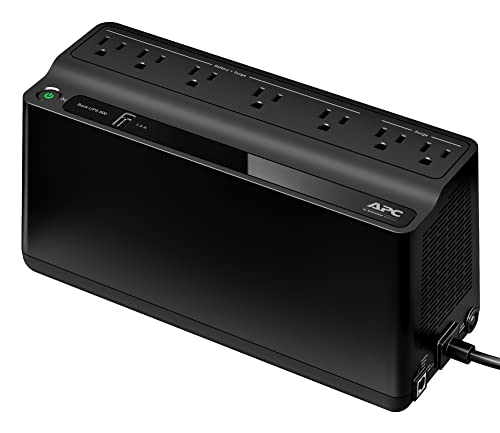
Pros
- Five battery-backed outlets
- Replaceable internal battery
- USB charging during outages
Cons
- 330W maximum capacity
- Who should skip it: users needing backup above 330W

Pros
- Sinewave output for active PFC power supplies
- AVR and detailed color status display
- Six battery-backup outlets and six surge-only outlets
Cons
- Only six of the 12 outlets provide battery backup
- Who should skip it: buyers needing a lightweight UPS

Pros
- Eight battery-backed outlets
- 230Wh LiFePO4 battery
- Pure sine wave output
- Wall-mount design
Cons
- Generator power may not be recognized or recharge the battery
- Who should skip it: generator-dependent setups
Best Overall UPS for Small-Business Workstations: CyberPower CP1500PFCLCD 1500VA UPS
CyberPower CP1500PFCLCD 1500VA UPS combines 1500VA/1000W capacity with pure sine wave output, AVR, and a color LCD, making it a strong feature match for a workstation with an active PFC power supply. It has six battery-backed outlets among 12 total, so check which devices need outage power. Skip it if you do not need sine wave output or its 1000W rating.
Best 1500VA UPS for Multiple Devices: APC BX1500M 1500VA UPS
APC BX1500M 1500VA UPS provides 900W capacity, 10 protected outlets, AVR, and an LCD showing estimated runtime and connected load. Its five battery-backup outlets make device prioritization important, and the battery is replaceable with the specified APC model. Skip it if you need more than five battery-backed outlets or pure sine wave output.
Best Compact UPS for Network and Office Gear: CyberPower EC850LCD 850VA UPS
CyberPower EC850LCD 850VA UPS offers 510W capacity, 12 outlets, and an LCD, with six outlets providing battery backup. Its ECO-controlled outlets can switch off connected peripherals when the UPS detects a computer is off or asleep. Skip it if your measured load exceeds 510W or you need pure sine wave output.
Best Lithium UPS for Long-Term Battery Planning: GOLDENMATE 1500VA/1000W LiFePO4 UPS
GOLDENMATE 1500VA/1000W LiFePO4 UPS pairs a 1500VA/1000W rating with pure sine wave output and eight battery-backed outlets. Its LiFePO4 battery is described as supporting 3000+ charge cycles, and the unit includes a communication port for automatic shutdown through a connected computer or NAS. Skip it if your outlet or generator setup does not meet its stated 90–140V AC input requirements, or if you do not need its battery chemistry and features.
Key Numbers at a Glance
- Highest stated wattage among the picks: GOLDENMATE 1500VA/1000W LiFePO4 UPS and CyberPower CP1500PFCLCD 1500VA UPS at 1000W.
- CyberPower CP1500PFCLCD 1500VA UPS has 12 outlets, with six battery-backed; APC BX1500M 1500VA UPS has 10 outlets, with five battery-backed.
- CyberPower EC850LCD 850VA UPS is rated at 510W, while Amazon Basics UPS, 800VA/450W is rated at 450W.
- Amazon Basics UPS, 800VA/450W specifies approximately 12 minutes at half load and approximately 2 minutes at full load.
How to Choose the Best UPS Battery Backup for Small Business
Match wattage to the equipment load
Bottom line: Add up the wattage of the equipment that must stay on, then leave operating headroom below the UPS rating. The listed options range from 255W for APC BE425M 425VA UPS Battery Backup to 1000W for CyberPower CP1500PFCLCD 1500VA UPS and GOLDENMATE 1500VA/1000W LiFePO4 UPS. Amazon Basics recommends keeping its load below 80% of rated capacity. Check equipment labels or manufacturer specifications, and include the computer, monitor, and network devices you plan to back up.
Choose battery-backed outlets for critical gear
Bottom line: Count the devices that need outage power, not just the total outlet count. CyberPower CP1500AVRLCD3 1500VA UPS has six battery-backed outlets among 12, while APC BX1500M 1500VA UPS has five among 10. Surge-only outlets can suit nonessential peripherals, but a device plugged into one will not receive battery backup during an outage. Map each device to the correct outlet before connecting the system.
Consider power output and AVR
Bottom line: AVR is useful when you want the UPS to correct minor voltage fluctuations without switching to battery. CyberPower CP1500PFCLCD 1500VA UPS and APC BX1500M 1500VA UPS both list AVR, while CyberPower ST425 425VA UPS is a standby model. The CyberPower CP1500PFCLCD also specifies pure sine wave output for active PFC and conventional power supplies; CyberPower CP1500AVRLCD3 specifies simulated sine wave output. Check your computer power supply guidance if waveform compatibility is a concern.
Plan runtime around a safe shutdown
Bottom line: Treat runtime as load-dependent, and prioritize saving work or shutting equipment down safely. The Amazon Basics unit lists approximately 12 minutes at 225W and approximately 2 minutes at 450W. APC BX1500M lists up to 68 minutes at a 100W load, but that figure is not a prediction for a higher-load workstation. Compare the load-specific figures with your needs, and avoid assuming a low-load runtime applies to a full office setup.
Decide whether monitoring and shutdown features matter
Bottom line: Choose a display or communication feature if it helps you monitor load or automate shutdown. APC BX1500M shows connected load and estimated runtime on its LCD, and CyberPower CP1500AVRLCD3 displays battery and power conditions. GOLDENMATE 1500VA/1000W LiFePO4 UPS lists a communication port for automatic safe shutdown with a connected Windows PC, Mac, or NAS. Confirm operating-system and software requirements before relying on automatic shutdown.
How We Compared These Products
This guide compares the listed wattage and VA ratings, battery-backed outlet counts, stated runtime examples, output type, AVR, monitoring, battery features, and warranty details. The guide is based on product research rather than firsthand evaluation; runtime and other performance claims are manufacturer-listed figures, not guarantees for every connected load.
Which Option Fits Your Small Business?
For a workstation that needs pure sine wave output and 1000W capacity, CyberPower CP1500PFCLCD 1500VA UPS offers six battery-backed outlets and AVR. Skip it if your priority is a lower-capacity UPS for networking equipment alone.
For a business that wants an LCD, AVR, and a replaceable battery, APC BX1500M 1500VA UPS has a 900W rating and five battery-backed outlets. Skip it if five backed-up outlets are not enough for your critical equipment.
For a network closet or workstation where long-term battery cycle life is a priority, GOLDENMATE 1500VA/1000W LiFePO4 UPS lists a 3000+ cycle battery and communication-based shutdown support. Skip it if you cannot verify that your power source meets its stated input requirements.
If the UPS is mainly for a router and modem, a smaller unit may fit better than a 1500VA model. Compare the best UPS battery backup for WiFi router options, and use the best UPS battery backup for computer guide to compare computer-focused capacity and runtime choices.
Mistakes to Avoid When Choosing a Small-Business UPS
- Buying by VA rating alone. Compare the wattage rating with the combined draw of the equipment you intend to back up.
- Counting every outlet as battery-backed. Check the outlet layout because many models split battery backup and surge-only outlets.
- Assuming runtime stays constant. Runtime falls as connected load rises; use load-specific figures and keep shutdown time in mind.
- Ignoring output type and input power. Check power-supply guidance for waveform needs and confirm the UPS input suits your electrical setup.
Frequently Asked Questions
How many watts should a small-business UPS have?
There is no single wattage for every business. Add the draw of the devices that need backup, then select a UPS whose wattage rating exceeds that total with room to spare. The listed models range from 255W to 1000W.
Can I plug a laser printer into a UPS?
Check the printer manufacturer’s power requirements and the UPS documentation before connecting one. The listed product details do not specify printer compatibility, and equipment with substantial power draw can exceed a UPS’s rated capacity.
What is the difference between battery backup and surge-only outlets?
Battery-backed outlets provide backup power during an outage as well as surge protection. Surge-only outlets protect against surges but do not supply battery power when utility power fails, so reserve backed-up outlets for critical devices.
Is pure sine wave output necessary for a business computer?
It depends on the power supply and the manufacturer’s guidance. CyberPower CP1500PFCLCD 1500VA UPS specifies pure sine wave output for active PFC and conventional power supplies, while CyberPower CP1500AVRLCD3 specifies simulated sine wave output. Verify the computer power supply’s requirements before choosing.
Can a UPS keep my office network running during an outage?
A UPS can provide temporary battery power to connected networking equipment if the devices are plugged into battery-backed outlets and their combined load is within the unit’s rating. Runtime depends on load, so include the router, modem, and any other equipment you need to keep online when estimating capacity.
Do UPS batteries need replacement?
Battery type and replacement details vary by model. APC BX1500M lists a user-replaceable battery, and APC BE650M1 lists a replaceable battery sold separately. Check the model’s documentation for the correct battery and maintenance instructions.

Write Your Review
No reviews yet. Be the first to share your experience!