

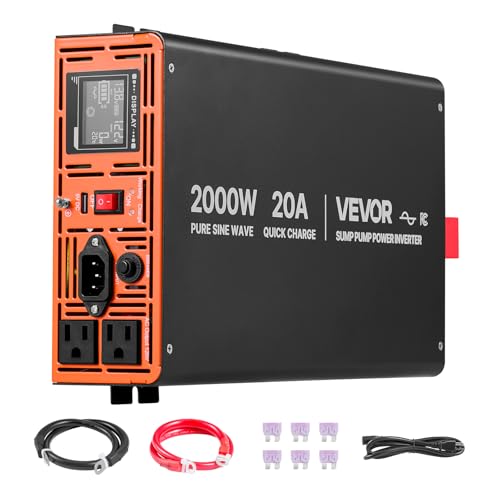
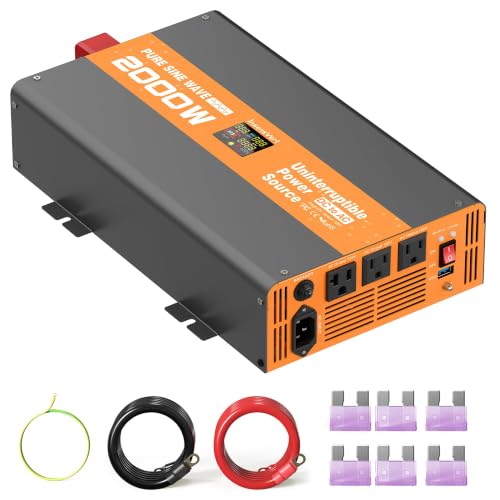

If your basement depends on a sump pump, a backup needs to handle the pump’s running load and startup demand while working with a compatible deep-cycle battery. This guide to the best ups battery backup for sump pump compares inverter wattage, battery charging, outlets, and monitoring so you can narrow the choices to your pump and outage plan.
Compare at a glance
| Product | Brand | Size | Stands out for | Price |
|---|---|---|---|---|
| 1 MWXNE 2000W Sump Pump Battery Backup | MWXNE | 16 × 6.7 × 4 in | Automatic grid-to-battery switchover | Check price |
| 2 VEVOR 2000W Sump Pump Battery Backup | VEVOR | 15.75 × 9.45 × 3.23 in | 2000W pure sine wave output | Check price |
| 3 InsensVert 2000W Sump Pump Backup | InsensVert | 9.5 × 15.8 × 3.4 in | 2000W continuous, 4000W peak output | Check price |
| 4 Sunivora 2000W Sump Pump Backup | Sunivora | 11.73 × 5.91 × 3.5 in | Three AC sockets | Check price |
| 5 OLTEANP 1500W Sump Pump Backup Inverter | OLTEANP | 13.78 × 5.91 × 3.15 in | Automatic transfer to battery power | Check price |
| 6 Sunivora 3000W Sump Pump Backup | Sunivora | 16.34 × 5.94 × 3.58 in | Pure sine wave output | Check price |
| 7 VIOPUMPO 2500W Sump Pump Backup System | VIOPUMPO | Not listed | Automatic grid-to-battery switching | Check price |
| 8 OLTEANP 2000W Sump Pump Backup Inverter | OLTEANP | 13.78 × 5.91 × 3.15 in | Automatic transfer to battery power | Check price |
| 9 VIOPUMPO 2500W Sump Pump Backup System | VIOPUMPO | 16.93 × 3.95 × 7.2 in | Automatic power switching | Check price |
| 10 OLTEANP 2500W Sump Pump Backup | OLTEANP | 16.93 × 7.87 × 4.33 in | Automatic grid-to-battery transfer | Check price |
Sizes and weights as listed by the manufacturer on Amazon. Check the retailer for current price and availability.
Pros
- Automatic grid-to-battery switchover
- Pure sine wave output
- Built-in 20A battery charger
- Multiple listed protection features
Cons
- Who should skip it: buyers needing a battery included
Pros
- 2000W pure sine wave output
- Automatic switching for continuous operation
- Supports several 12V battery types
- LCD status display
Cons
- Battery not included
- Who should skip it: owners of pumps over 1 HP
Pros
- 2000W continuous, 4000W peak output
- Three AC outlets
- LCD status monitoring
- Supports several listed battery types
Cons
- Battery runtime is not specified
- Who should skip it: buyers needing a stated runtime or battery included

Pros
- Three AC sockets
- Automatic outage switching
- 20-amp three-stage charging
- LED voltage display
Cons
- Battery is not listed among included items
- Who should skip it: buyers needing a battery included

Pros
- Automatic transfer to battery power
- 25A multi-stage battery charger
- LCD remote monitoring
- Three AC outlets
Cons
- Who should skip it: owners who need an included battery

Pros
- Pure sine wave output
- Three AC sockets and hardwired terminals
- 20-amp, three-stage charging
- LCD voltage display
Cons
- Who should skip it: plug-only users above 2,000W

Pros
- Automatic grid-to-battery switching
- Three grounded AC outlets
- Remote LCD status display
- Adjustable input voltage
Cons
- Battery must be purchased separately
- Who should skip it: buyers needing a complete battery-included system

Pros
- Automatic transfer to battery power
- Built-in 25A multi-stage charger
- LCD remote monitoring
- Three AC outlets
Cons
- Battery not included
- Hardwire output must not connect to utility or generator power
- Who should skip it: buyers who need a battery included

Pros
- Automatic power switching
- 25A built-in battery charger
- LCD remote monitoring
- Flat or wall mounting
Cons
- Not suitable for non-deep-cycle batteries
- Certification details are not specified

Pros
- Automatic grid-to-battery transfer
- 25A multi-stage battery charger
- LCD remote status monitoring
- Supports several deep-cycle battery types
Cons
- Who should skip it: buyers who need an included battery
Key Numbers at a Glance
- Listed continuous output ranges from 1500W on OLTEANP 1500W Sump Pump Battery Backup System for Basement to 3000W on SUNIVORA 3000W Sump Pump Battery Backup System.
- Charging current is 20A on MWXNE 2000W Sump Pump Battery Backup System and 25A on OLTEANP 2500W Sump Pump Battery Backup System for Basement.
- OLTEANP 1500W Sump Pump Battery Backup System for Basement lists overall dimensions of 16.61 × 9.13 × 4.41 inches; the OLTEANP 2000W and 2500W versions list 19.06 × 9.53 × 4.29 inches.
- InsensVert 2000W Sump Pump Battery Backup lists 4000W peak output, while VEVOR 2000W Sump Pump Battery Backup System LCD is described for pumps up to 1 HP.
Best 3000W Sump Pump Backup for Higher Output: SUNIVORA 3000W Sump Pump Battery Backup System
SUNIVORA 3000W Sump Pump Battery Backup System lists 3000W pure sine wave output, three AC sockets, and hard-wired terminals, giving buyers multiple connection approaches. The listing also describes a 20A charger and LCD display, but its hard-wiring instructions require care: it says not to use power cords and hard-wired AC inputs simultaneously. Skip it if you want a battery included, since the listed package does not state that one is included.
Best for a 1 HP Pump: VEVOR 2000W Sump Pump Battery Backup System LCD
VEVOR 2000W Sump Pump Battery Backup System LCD is described for sump pumps up to 1 HP and includes an AC outlet, USB port, and LCD monitoring. Its 3-stage charger supports 12V lead-acid, AGM, Gel, and LiFePO4 batteries. Skip it if your pump exceeds the stated 1 HP scope or you need several AC outlets, since the listing specifies one.
Best for a Compact Listed Footprint: OLTEANP 1500W Sump Pump Battery Backup System for Basement
OLTEANP 1500W Sump Pump Battery Backup System for Basement lists overall dimensions of 16.61 × 9.13 × 4.41 inches and three AC outlets, plus USB and Type-C ports. Its 1500W output is lower than the 2000W and 2500W OLTEANP versions, so confirm the pump’s load before choosing it. Skip it if your pump’s requirements exceed its continuous output or you need a battery included.
Best for Remote Monitoring: OLTEANP 2500W Sump Pump Battery Backup System for Basement
OLTEANP 2500W Sump Pump Battery Backup System for Basement combines 2500W pure sine wave output with a wired LCD remote that displays battery voltage, load status, and operating mode. It lists a 25A charger, three AC outlets, and compatibility with LiFePO4, AGM, GEL, and flooded deep-cycle batteries. Skip it if you need a plug-only installation or a battery in the box; the listing describes hard-wire terminals and says a battery is required but not included.
Best UPS Battery Backup for Sump Pump: What to Check
Match continuous and startup power
Bottom line: Choose an inverter with enough continuous output for your pump and enough surge capacity for startup. The listings span 1500W, 2000W, 2500W, and 3000W continuous output; InsensVert lists 4000W peak output alongside 2000W continuous output. A higher wattage number alone does not confirm compatibility, so check the pump label or manual for running watts, startup demand, and voltage before buying. For other home backup loads, compare the guidance in our best ups battery backup for home guide.
Check battery voltage, chemistry, and runtime needs
Bottom line: Verify the battery voltage and chemistry, then size capacity around the outage you need to cover. Several models specify a 12V battery, and VEVOR lists lead-acid, AGM, Gel, and LiFePO4 compatibility; OLTEANP lists LiFePO4, AGM, GEL, and flooded deep-cycle batteries. Most products here state that the battery is not included, and the product data does not establish runtime because it depends on battery capacity and pump cycling. Ask the manufacturer to confirm compatibility if your battery type is not named.
Compare transfer, charger, and monitoring features
Bottom line: Prioritize automatic transfer and a charger suited to your recharge needs. MWXNE lists transfer in under 10 ms and a 20A charger; the OLTEANP 2500W model lists a 25A charger and wired LCD remote. These figures describe different features, not a guarantee of uninterrupted operation with every pump. Check the pump manufacturer’s guidance on acceptable transfer time, and consider whether a remote display is useful where the inverter will be mounted.
Plan outlets, installation, and physical clearance
Bottom line: Match the connection method and available space to your installation before ordering. SUNIVORA 3000W lists three AC sockets plus hard-wired terminals, while the VEVOR model lists one AC outlet and a USB port. OLTEANP publishes dimensions for its 1500W and higher-output versions, but leave extra room for ventilation and battery cables. Check whether your pump plug reaches the unit and follow the manual; do not improvise electrical connections in a damp area.
How We Compared These Products
This guide is based on product research, not firsthand evaluation. We compared the listed continuous and peak wattage, battery compatibility, charger current, transfer and monitoring features, connection options, dimensions where stated, and support terms. The product pages provide limited customer-feedback detail, so the recommendations rely on stated specifications rather than a claim of proven performance.
Which Option Fits Your Home and Devices?
If your pump is within the VEVOR listing’s stated 1 HP scope and you want a single AC outlet with a USB port, the VEVOR model is the direct feature match. If a remote display and 25A charging matter more, the OLTEANP 2500W model lists both; for broader home-electronics backup comparisons, see best ups battery backup for computer and best ups battery backup for gaming pc. Choose by pump requirements and battery plan first, not by outlet count alone.
Mistakes to Avoid When Choosing a Sump Pump Backup
- Choosing by wattage alone. Confirm running and startup requirements in the pump manual, then compare them with the inverter’s continuous and peak ratings.
- Assuming the battery is included. Many listings describe the battery as not included; verify the package contents and buy a compatible deep-cycle battery separately if required.
- Ignoring battery chemistry. Match the inverter’s stated battery compatibility to the battery you own or plan to buy, and confirm details with the manufacturer if unclear.
- Overlooking installation conditions. Check dimensions, cable reach, ventilation clearance, outlet access, and the manual’s electrical instructions before placing the inverter.
Because these systems connect to household power and may be used near water, follow the manufacturer instructions and applicable local electrical requirements. Have a qualified electrician handle hard-wired connections or any installation you are not equipped to complete safely.
Frequently Asked Questions
Do these sump pump backups include a battery?
Several listings explicitly say the battery is not included, including the VEVOR and OLTEANP models. Check the package details for the exact model before ordering, and confirm the battery type and voltage it supports.
How do I know what wattage my sump pump needs?
Check the pump label or manual for its electrical requirements, including startup demand if stated. Compare those requirements with the inverter’s continuous and peak output; the product wattage alone cannot establish compatibility.
Can I use a LiFePO4 battery with these systems?
Some product pages list LiFePO4 compatibility, including VEVOR and the OLTEANP models. Compatibility is model-specific, so confirm the exact battery voltage and charging requirements in the manufacturer’s documentation.
How long will a sump pump run on battery backup?
The listed inverter wattage and charger current do not establish runtime. Runtime depends on the battery capacity, pump load, and how often the pump runs; check with the inverter and battery manufacturers for an estimate based on your setup.
Is a 1500W or 2000W backup better for a sump pump?
Neither rating is automatically the right choice: match the inverter to the pump’s running and startup requirements. OLTEANP lists 1500W and 2000W versions, while VEVOR describes its 2000W model for pumps up to 1 HP; verify your pump’s specifications before choosing.


Write Your Review
No reviews yet. Be the first to share your experience!