


For a home PC and router, the right UPS depends on the combined wattage you need to keep running and how long you need backup power. Smaller units such as the CyberPower ST425 425VA UPS suit lighter loads, while 1500VA models provide higher rated output; the CyberPower CP1500PFCLCD 1500VA UPS adds sine wave output for compatible active PFC power supplies.
This guide to the best ups battery backup for home compares capacity, outlet types, voltage regulation, monitoring, and battery design. Check your equipment’s power draw and the UPS’s watt rating before connecting a desktop, monitor, router, or NAS.
Compare at a glance
| Product | Brand | Size | Weight | Stands out for | Price |
|---|---|---|---|---|---|
| 1 Amazon Basics UPS, 800VA/450W | Amazon Basics | 12.2 × 7 × 3.14 in | 9.4 lb | 12 total outlets | Check price |
| 2 CyberPower ST425 425VA UPS | CyberPower | 3.2 × 8.3 × 4.5 in | 3.8 lb | Battery backup and surge protection on four outlets | Check price |
| 3 APC BX1500M 1500VA UPS | APC | 15.04 × 3.94 × 9.84 in | 24 lb | 1500VA/900W capacity | Check price |
| 4 CyberPower CP1500PFCLCD 1500VA UPS | CyberPower | 14 × 3.9 × 11 in | 25 lb | Sinewave output for active PFC power supplies | Check price |
| 5 APC BE650G1 UPS Battery Backup | APC | 7.09 × 11.18 × 3.39 in | 14 lb | Eight outlets across backup and surge-only groups | Check price |
| 6 CyberPower EC850LCD 850VA UPS | CyberPower | 12.2 × 7 × 3.1 in | 7.7 lb | Multifunction LCD panel | Check price |
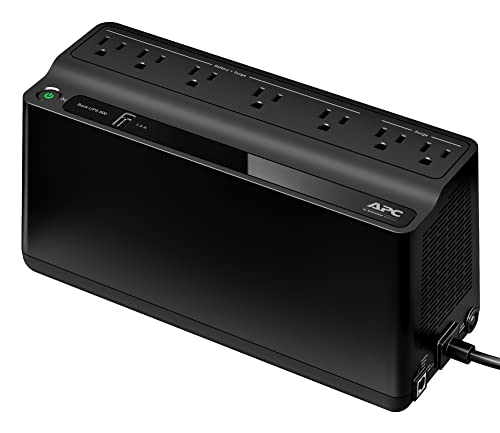
| 7 APC BE600M1 600VA UPS | APC | 10.79 × 4.13 × 5.47 in | 7.5 lb | Five battery-backed outlets | Check price |
| 8 CyberPower ST625U 625VA UPS | CyberPower | 3.2 × 9.8 × 5.8 in | 5 lb | Four battery-backed outlets | Check price |
Sizes and weights as listed by the manufacturer on Amazon. Check the retailer for current price and availability.
Pros
- 12 total outlets
- Six battery-backup outlets
- Compact dimensions
- 5-foot power cord
Cons
- Who should skip it: users needing extended backup time
Pros
- Battery backup and surge protection on four outlets
- Four additional surge-protected outlets
- Three-year warranty includes the battery
Cons
- Who should skip it: users whose equipment exceeds 260W
Pros
- 1500VA/900W capacity
- AVR voltage regulation
- LCD status display
- User-replaceable battery
- UL certified
Cons
- Only five outlets provide battery backup
- Who should skip it: users needing battery backup for more than five devices

Pros
- Sinewave output for active PFC power supplies
- AVR and detailed color status display
- Six battery-backup outlets and six surge-only outlets
Cons
- Only six of the 12 outlets provide battery backup
- Who should skip it: buyers needing a lightweight UPS

Pros
- Eight outlets across backup and surge-only groups
- User-replaceable battery
- RJ45 Ethernet surge protection
Cons
- Who should skip it: users needing over four battery-backed outlets

Pros
- Multifunction LCD panel
- 12 total outlets
- Three-year warranty includes battery
- ECO-controlled outlets
Cons
- Only six outlets provide battery backup
- Who should skip it: users needing more than 510W
Pros
- Five battery-backed outlets
- Replaceable internal battery
- USB charging during outages
Cons
- 330W maximum capacity
- Who should skip it: users needing backup above 330W

Pros
- Four battery-backed outlets
- Two USB charging ports
- Three-year warranty includes battery
- Compact listed dimensions
Cons
- 360W maximum capacity
- Who should skip it: users needing all eight outlets battery-backed
Best for Active PFC PCs: CyberPower CP1500PFCLCD 1500VA UPS
CyberPower CP1500PFCLCD 1500VA UPS pairs 1500VA/1000W capacity with sine wave output, a feature specified for active PFC and conventional power supplies. It has six battery-backup outlets, six surge-only outlets, AVR, and a color LCD. Its 12 outlets do not all provide battery backup.
Skip it if your load fits a lower-capacity unit or you need every outlet to have battery backup.
Best for Higher Output and AVR: APC BX1500M 1500VA UPS
APC BX1500M 1500VA UPS is rated at 1500VA/900W and includes AVR, an LCD, and five battery-backup outlets. The manufacturer lists up to 68 minutes at a 100W load, but runtime changes with connected equipment and load.
Skip it if sine wave output is a requirement; this listing does not specify that feature.
Related guides: Best UPS Battery Backup for Computer, Best UPS Battery Backup for Small Business and Best UPS Battery Backup for Sump Pump.
Best for Long-Life Battery Design: GOLDENMATE 1000VA/800W LiFePO4 UPS
GOLDENMATE 1000VA/800W LiFePO4 UPS combines 1000VA/800W capacity, pure sine wave output, eight battery-backup outlets, and a 230Wh LiFePO4 battery. The manufacturer claims more than 10 years of battery life and over 5,000 charge cycles; it also notes the cooling fan can activate during heavy battery use.
Skip it if fan noise is a concern or you do not need its lithium battery design.
Best Compact Choice for Light Loads: CyberPower ST425 425VA UPS
CyberPower ST425 425VA UPS has a compact design and an output rating of 425VA/260W, with four battery-backup outlets and four surge-only outlets. It uses simulated sine wave output, so it is aimed at lighter setups rather than high-wattage desktop loads.
Skip it if your equipment’s combined draw approaches or exceeds 260W.
Key Numbers at a Glance
- Listed output ranges from 425VA/260W on the CyberPower ST425 425VA UPS to 1500VA/1000W on the CyberPower CP1500PFCLCD 1500VA UPS.
- The APC BX1500M 1500VA UPS lists 10 outlets, while the CyberPower CP1500PFCLCD 1500VA UPS lists 12.
- The CyberPower CP1500PFCLCD 1500VA UPS has six battery-backup outlets; the APC BX1500M 1500VA UPS has five.
- The GOLDENMATE 1000VA/800W LiFePO4 UPS specifies a 230Wh battery and eight outlets with battery backup and surge protection.
How to Choose the Best UPS Battery Backup for Home
Match rated watts to your equipment
Bottom line: Add up the connected load and keep it below the UPS watt rating. The CyberPower ST425 425VA UPS is rated for 260W, while the CyberPower CP1500PFCLCD 1500VA UPS is rated for 1000W. A larger VA number alone does not tell you whether a unit can support your PC; compare watts and leave headroom, especially if a gaming desktop and monitor share the backup load.
Estimate runtime at your actual load
Bottom line: Use runtime figures only at the stated load, then account for your own devices. APC lists up to 68 minutes for the BX1500M at 100W and 23 minutes for the BE600M1 at 100W. Those figures are not predictions for a desktop drawing more power; check the manufacturer’s runtime information against your estimated load.
Count battery-backed outlets, not just total outlets
Bottom line: Reserve battery outlets for devices that need to stay on during an outage. The Amazon Basics UPS, 800VA/450W has 12 outlets, split evenly between six battery-backup/surge outlets and six surge-only outlets. The CyberPower CP1500AVRLCD3 1500VA UPS has 12 outlets too, with six battery-backed and six surge-only, so count the outlets you need for a PC, monitor, and network gear.
Choose output type and voltage correction for your setup
Bottom line: Check power-supply requirements and decide whether AVR or sine wave output matters. The CyberPower CP1500PFCLCD 1500VA UPS specifies sine wave output for active PFC and conventional power supplies, while the CP1500AVRLCD3 uses simulated sine wave and AVR. If compatibility is uncertain, check your PC power-supply documentation and the UPS manufacturer’s guidance before buying.
Consider monitoring and battery replacement
Bottom line: An LCD and a replaceable battery can make upkeep and status checks more straightforward. The APC BX1500M shows estimated runtime, load, charge, and input voltage on its LCD, and its battery is replaceable. The APC BE600M1 also has a replaceable battery, while the CyberPower EC850LCD 850VA UPS adds an LCD and ECO-controlled outlets for switching off selected peripherals when a computer is off or asleep.
How We Compared These Products
This comparison is based on product-page specifications and feature descriptions, including rated VA and watts, outlet layouts, stated runtime, output type, AVR, monitoring, and battery details. It is product research rather than firsthand evaluation. Runtime and compatibility depend on the connected equipment and actual electrical load.
Browse the UPS and surge protectors category for related power-protection options, or explore PC accessories for other additions to a home workstation.
Which Option Fits Your Home and Devices?
For an active PFC desktop that needs sine wave output: the CyberPower CP1500PFCLCD 1500VA UPS has 1000W rated output and six battery-backup outlets. Skip it if you do not need its higher capacity or sine wave feature.
For a lighter setup with a compact standby unit: the CyberPower ST425 425VA UPS provides 260W rated output and four battery-backup outlets. Skip it if your combined load exceeds its rating or you need more battery-backed outlets.
For a battery design with a stated long cycle life: the GOLDENMATE 1000VA/800W LiFePO4 UPS lists a 230Wh battery and pure sine wave output. Skip it if you want a unit without a cooling fan that can activate under heavy battery use.
Mistakes to Avoid When Choosing a Home UPS
- Choosing by VA alone. Compare the watt rating with the combined load of the devices you plan to back up.
- Assuming every outlet has battery backup. Check the outlet breakdown; several models divide battery-backed and surge-only outlets.
- Expecting the listed runtime at any load. Match the runtime claim to its stated wattage and consult manufacturer runtime information for your expected draw.
- Ignoring output type. Check your computer power supply’s requirements and verify compatibility with the UPS manufacturer when sine wave output may matter.
Frequently Asked Questions
What size UPS do I need for a home PC?
Add the watt draw of the PC and any devices you want on battery, such as a monitor or router. Choose a UPS with a watt rating above that total, and use the manufacturer’s runtime information to estimate backup time.
Can I plug a gaming PC into a UPS?
Yes, if the PC’s power draw stays within the UPS watt rating and the power supply is compatible with its output. The CyberPower CP1500PFCLCD specifies sine wave output for active PFC and conventional supplies; check your PC power-supply documentation before choosing.
Should my monitor and router use battery-backup outlets?
Use battery-backed outlets for devices you want powered during an outage, while surge-only outlets protect devices without providing battery power. Since these units have limited battery-backed outlets, plan the layout around your PC, monitor, router, or NAS priorities.
Does AVR replace battery backup?
No. AVR corrects some voltage fluctuations without switching to battery, according to the APC BX1500M and CyberPower models that list the feature. Battery backup serves a different purpose during power interruptions.
Can I replace a UPS battery?
Some models in this comparison specify user-replaceable batteries, including the APC BX1500M and APC BE600M1. Check the exact replacement model and instructions for the UPS you choose; the listings identify replacement batteries sold separately.

Write Your Review
No reviews yet. Be the first to share your experience!